
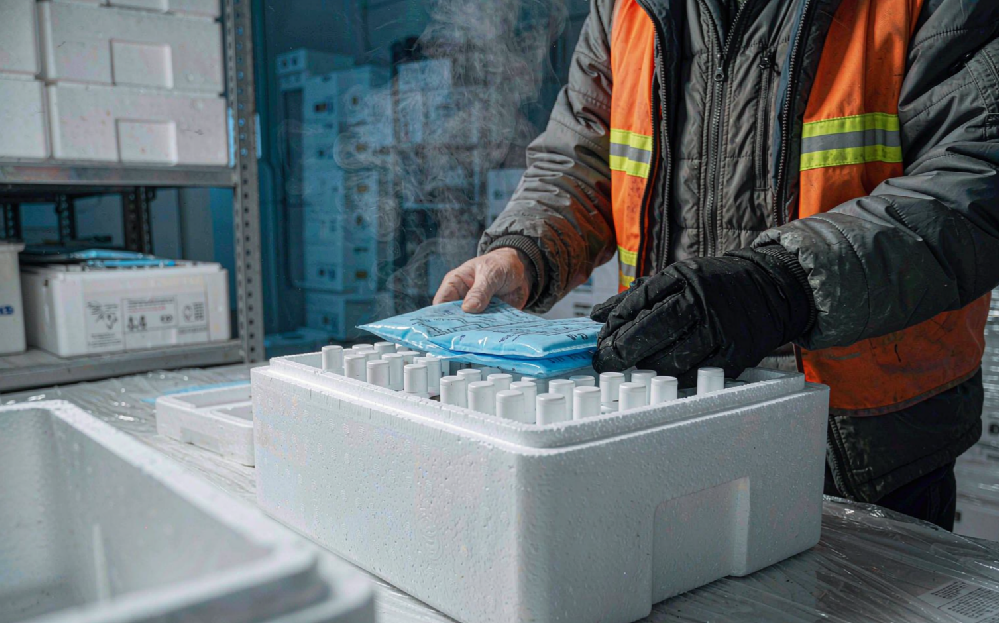
Ask anyone who's run a long-haul cold chain shipment and they'll have a dry ice story. The logistics manager who calculated consumption rates for a pharmaceutical payload, loaded accordingly, and watched the delivery arrive two days late due to a customs hold — by which point most of the dry ice had sublimated away, leaving temperature logs trending upward into the danger zone. The lab supplier balancing between packing enough dry ice to survive a flight and keeping the payload light enough to stay within airline Dangerous Goods limits. The export team wrestling with export declarations, hazmat paperwork, and crew safety protocols every single dispatch.
Dry ice, solid carbon dioxide at minus 78.5 degrees Celsius, has been a cold chain workhorse for decades. It's cheap to buy, readily available, and packs a substantial cooling punch per kilogram. But it carries a set of structural limitations that become more painful the longer and more complex your cold chain becomes. And as shippers demand better temperature control, lower risk, and more predictable costs, a growing number are exploring reusable phase change coolants as an alternative.
Let's start with the most obvious problem: wastage. Dry ice sublimates continuously from the moment it's produced. Store it in an insulated container and you might get three to five days before significant losses set in. Leave it exposed to ambient conditions and you're measuring loss in hours. Every delay, every layover, every unscheduled stop is more carbon dioxide drifting into the atmosphere and less cooling available for the cargo. Shippers compensate by overpacking — but that adds weight, cuts payload capacity, and burns more fuel in transit. It's a vicious cycle where uncertainty drives waste, and waste drives cost.

Then there's the temperature problem. Dry ice sits at a fixed minus 78.5 degrees Celsius. That's fine if you're shipping biological samples that need deep cryogenic preservation. But what about fresh produce, which prefers 2 to 4 degrees above zero? Or some vaccines that stabilize between 2 and 8 degrees Celsius but will degrade if frozen? Dry ice delivers one temperature, indiscriminately, everywhere. Some shippers try to mitigate this with layer separation — dry ice on the bottom, a barrier layer, then product on top. But that's a rough approximation, not precision temperature management. Temperature probes from field deployments frequently show swings of 15 to 20 degrees Celsius within a single container as dry ice gradually dissipates and ambient temperatures seep in.
Reusable phase change coolants solve both of these problems by design. Glacier Thermal's coolant lineup, for instance, offers formulations with precise phase transition temperatures across a wide range — from minus 32 degrees Celsius for frozen logistics up through positive temperatures for fresh and pharmaceutical cargo. Each formulation is engineered to maintain its target temperature within a narrow band as it transitions between solid and liquid states. No sublimation, no continuous temperature drift, no guessing how much cooling will remain after a week in transit. The coolant is simply frozen before use, arranged within the shipping container alongside the cargo, and it holds temperature steadily until the phase transition completes. At the destination, the coolant blocks go back into a freezer and the cycle begins again.
The financial case compounds when you look at operating expenses over time. Dry ice is a consumable — every kilogram you buy is gone after use, and every shipment requires a fresh purchase. Reusable coolants require a capital expenditure upfront, but each unit can cycle 500 to 1000 times before performance degrades meaningfully. Spread that initial cost across hundreds of shipments and the per-use cost drops to a fraction of what dry ice costs. Add in the reduced waste from overpacking, the lighter containers that save on fuel, and the lower cargo loss rates from better temperature control, and the cumulative savings become substantial.
Safety also factors into the calculation. Dry ice displaces oxygen as it sublimates, which means confined spaces like truck trailers or aircraft cargo holds require ventilation protocols and monitoring. That's more training, more documentation, and more compliance overhead. Phase change coolants are non-toxic, non-flammable, and don't produce gas during use. They're classified as general cargo for most modes of transport, eliminating the hazmat paperwork, dangerous goods labeling, and restricted handling zones that slow down dry ice shipments. It's not just that this is safer for crew and ground staff — it also cuts down on transit delays triggered by paperwork errors or inspection failures.
The switch isn't universally straightforward. Deep-cryogenic applications below minus 40 degrees Celsius still favor dry ice or liquid nitrogen simply because few reusable coolants operate reliably in that extreme range. And the initial investment in coolant blocks plus the freezers needed to regenerate them requires some capital planning. But for the vast majority of cold chain operations — pharmaceutical distribution, fresh food logistics, temperature-sensitive e-commerce fulfillment — reusable coolants have reached the performance threshold where they're not just a good idea, they're the economically rational choice.
Glacier Thermal has been shipping its reusable coolants to customers across Asia, Europe, and North America for more than a decade. The company's data shows that clients typically see payback on their investment within 12 to 18 months of deployment, with ongoing savings of 30 to 60 percent on cold chain costs compared to dry ice operations. One pharmaceutical distributor in Japan reported eliminating 92 percent of temperature excursions in its domestic vaccine shipments after switching, and reduced annual cold chain expenses by roughly 45 percent.
The cold chain industry faces pressure from multiple directions: regulators demanding better temperature traceability and reporting, customers expecting more consistent delivery quality, and stakeholders pushing for lower carbon footprints. Dry ice has served its purpose, but its fundamental characteristics — continuous sublimation, fixed temperature output, single-use consumption — put it increasingly at odds with where the industry is headed. Reusable phase change coolants don't just match dry ice on performance for most applications; they outperform it on predictability, cost efficiency, and environmental impact.
For forward-thinking logistics teams, the question is no longer whether to make the switch. It's how to make it without disrupting existing operations. Most coolant suppliers offer container mapping services where thermal engineers analyze the volume, insulation properties, and typical transit profiles of each shipping configuration, then design a coolant layout that maintains target temperatures throughout the journey. It's a consultative process that replaces guesswork with data, and it's becoming standard practice among the more sophisticated cold chain operators.
The days of dry ice as the default cold chain solution are numbered. That's not a eulogy — dry ice will always have its niche in the deepest cryogenic applications. But for the overwhelming majority of temperature-sensitive cargo moving around the world today, reusable phase change coolants represent a better balance of performance, cost, safety, and environmental responsibility. And as the technology continues to improve — with formulations covering wider temperature ranges and more compact packaging designs — the gap will only widen.