
Solving the Temperature Uniformity Puzzle: How Baffle-Enhanced Immersion Cooling Is Revolutionizing Energy Storage
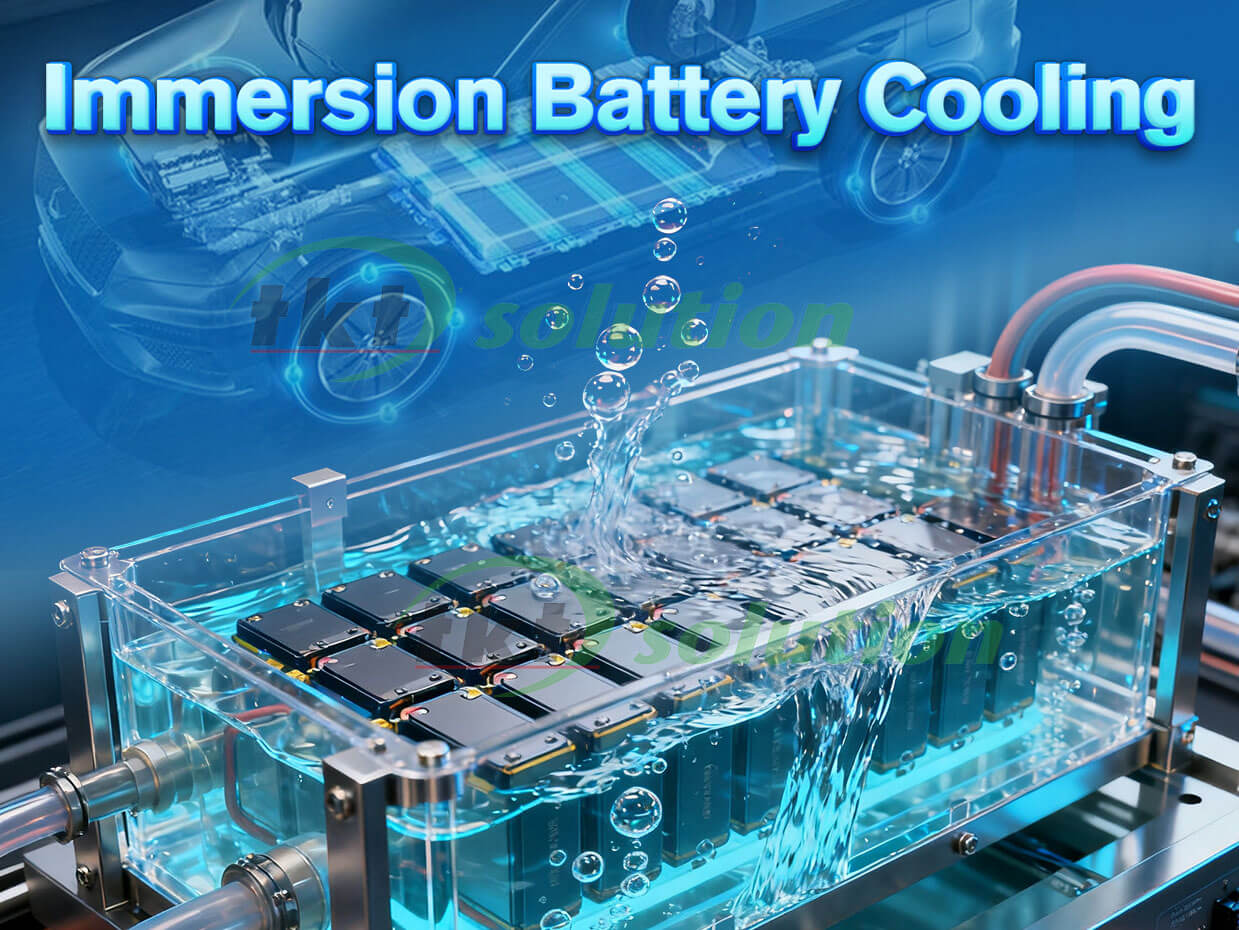
As energy storage batteries evolve toward higher energy density and longer cycle life, thermal management has moved from a supporting function to the central determinant of system safety and performance. The industry has long grappled with a stubborn set of interrelated problems: poor heat dissipation in the mid-to-rear sections of battery modules, uneven flow distribution, and localized hot spots that accelerate degradation and increase thermal runaway risk. These are not edge cases — they are inherent limitations of conventional cooling architectures.
A breakthrough design from Glacier Coolant researchers is now changing this equation. By incorporating baffle-plate internal components into immersion liquid cooling battery modules, the team has engineered a solution that actively guides cooling fluid into uniform distribution, fundamentally resolving the flow stagnation and uneven cooling that have plagued traditional designs.
The Challenge
In conventional immersion cooling modules, coolant flows along a path of least resistance. The front sections of the module receive abundant cooling, while the mid-to-rear sections suffer from flow stagnation. The result: a temperature gradient that can exceed 10°C across a single module, with rear cells consistently running hotter — and aging faster — than their front-row counterparts.
The Solution
Baffle plates are strategically positioned in the mid-to-rear sections of the battery module. These internal structures actively redirect coolant flow, forcing it to distribute evenly across all cell surfaces. By reconstructing the flow path, the baffles extend the effective heat exchange length and ensure every single cell receives balanced cooling — eliminating the hot spot problem at its source.
Measured Performance: Data That Speaks
The Glacier Coolant research team has rigorously quantified the performance improvements of the baffle-enhanced immersion cooling design through systematic experimental testing. The results are unambiguous:
Significantly LowerAverage temperature of high-temperature cells vs. conventional modules
Dramatically ReducedPeak local hot spot temperature across the module
Substantially SmallerMaximum temperature difference within the module
2.0% ErrorAverage relative error of proprietary Nusselt number correlation
Conventional Design
Uneven flow distribution
Flow stagnation in rear sections
Large inter-cell temperature gradients
Localized hot spots
Accelerated cell aging in hot zones
Limited predictive capability
Baffle-Enhanced Design
Actively guided uniform flow
Extended effective heat exchange length
Narrow inter-cell temperature spread
Hot spots virtually eliminated
Uniform aging across all cells
Precise Nusselt number prediction
Operational Flexibility: Tuning for Real-World Conditions
One of the most compelling features of the baffle-enhanced immersion cooling system is its tunability. The system provides two primary control levers for operators:
Coolant Flow Rate
Increasing the coolant flow velocity directly enhances heat transfer and narrows temperature differences across the module. The relationship is well-characterized: higher flow rates produce stronger convective heat transfer, more effective hot spot suppression, and tighter temperature uniformity. For high-power charge and discharge scenarios, elevated flow rates provide the thermal headroom needed to maintain safe operating temperatures.
Initial Coolant Temperature
The initial temperature of the cooling fluid can be optimized to balance heat exchange efficiency against temperature uniformity. Cooler initial temperatures increase the driving temperature difference for heat transfer, but must be managed carefully to avoid excessive temperature gradients. The system allows operators to dial in the optimal setpoint for any given operating condition, whether it is a grid-scale storage facility cycling daily or a fast-response frequency regulation system.
Engineering Science: The Nusselt Number Breakthrough
Behind the hardware innovation lies a significant theoretical contribution. The Glacier Coolant research team has developed a proprietary Nusselt number prediction correlation specifically calibrated for the baffle-enhanced immersion cooling geometry. The Nusselt number — a dimensionless parameter that characterizes convective heat transfer relative to conductive heat transfer — is the key to predicting system performance under varying conditions.
The team's correlation achieves an average relative error of just 2.0% when compared against experimental measurements. This level of predictive accuracy is remarkable for such a complex flow geometry and provides a reliable theoretical foundation for engineering design and operational optimization. System designers can now confidently predict heat transfer performance without relying on costly iterative prototyping.
The Pressure Drop Trade-off
No engineering solution comes without trade-offs, and the baffle-enhanced design is no exception. The baffle plates introduce a modest increase in pressure drop across the module — the fluid must work slightly harder to navigate the redirected flow paths. However, when weighed against the benefits — improved battery safety, extended cycle life, enhanced system stability, and predictable performance — the incremental pumping power cost is overwhelmingly justified.
The Glacier Coolant team has carefully optimized the baffle geometry to maximize the heat transfer benefit while minimizing the pressure drop penalty. The result is a design that achieves an excellent balance between technical performance and engineering practicality.
Applications Across the Energy Storage Landscape
The baffle-enhanced immersion cooling technology is designed for versatility across the full spectrum of energy storage applications:
Grid-scale storage power stations benefit from the enhanced safety profile and extended battery life, which directly reduce the levelized cost of storage (LCOS). In these multi-megawatt installations, even a small improvement in battery longevity translates into millions of dollars in deferred replacement costs.
Commercial and industrial distributed storage systems gain from the compact form factor and robust thermal management, enabling reliable operation in space-constrained urban environments where fire safety is paramount.
Data center backup power systems require the highest levels of reliability and safety. The immersion cooling system's inherent fire suppression characteristics — the dielectric coolant is both a heat transfer medium and a flame retardant — provide an additional layer of protection that air-cooled and cold-plate systems cannot match.
Toward a Greener Energy Future
As the global energy transition accelerates, battery energy storage is emerging as the linchpin technology that enables high renewable energy penetration. But storage systems are only as good as their thermal management. Batteries that overheat degrade faster, pose safety risks, and undermine the economic case for storage deployment.
The baffle-enhanced immersion cooling technology from Glacier Coolantaddresses these challenges at a fundamental level. By delivering superior heat dissipation, exceptional temperature uniformity, enhanced safety, and predictable performance, it solves the core thermal management bottleneck that has constrained the energy storage industry. As the technology continues to mature and scale, it will play an increasingly central role in enabling the global transition to a clean, reliable, and resilient energy system.