
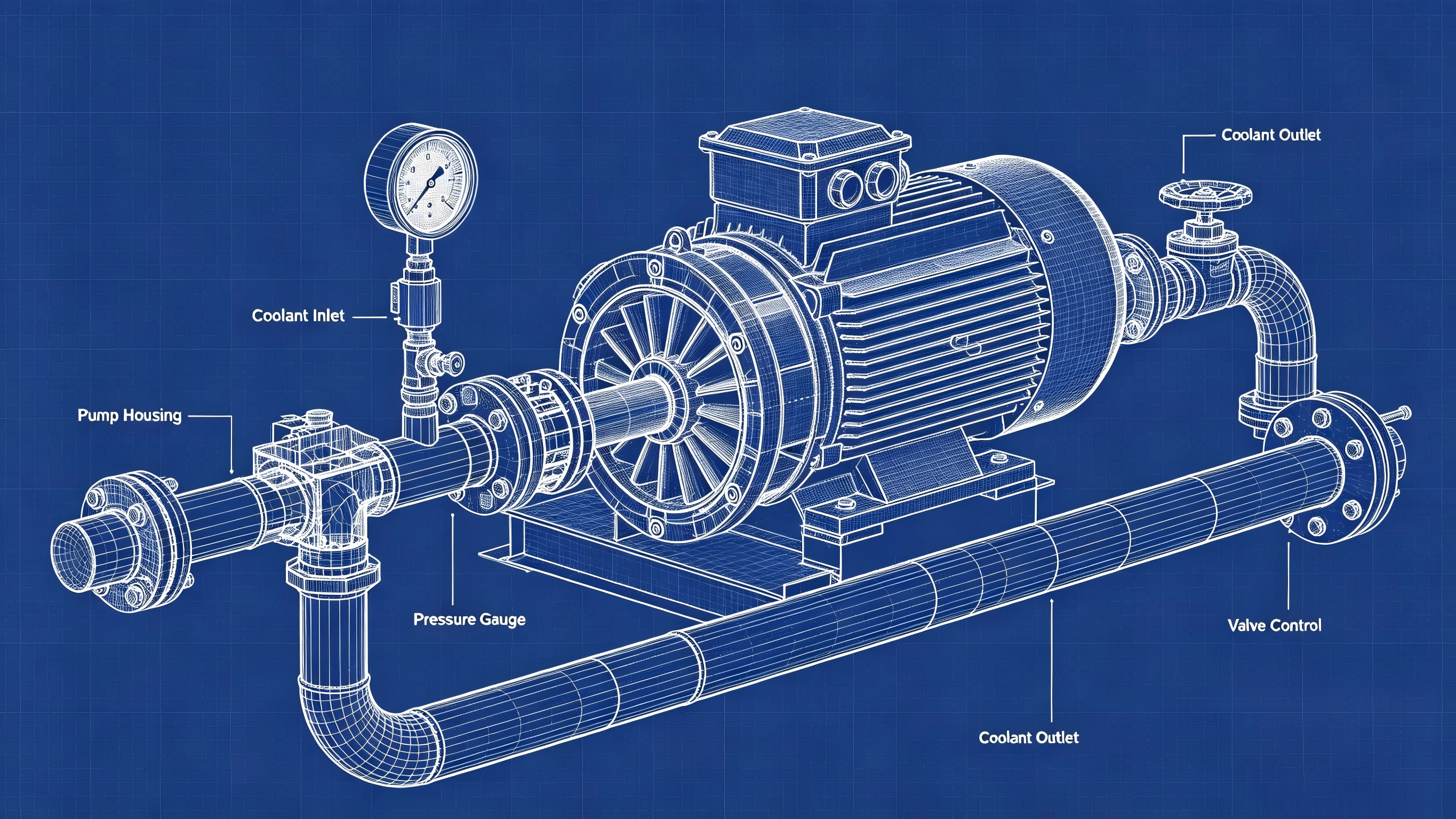
Walk into almost any large cold storage facility or food processing plant, and you'll hear the same sound: the low hum of pumps pushing coolant through miles of pipe. What you won't see is how much of that electricity is doing nothing useful.
Industry estimates suggest that pumping energy accounts for 15–25% of total refrigeration electricity use. But according to emerging research from Glacier Coolant, a significant portion of that energy is simply wasted — overcome not by cooling demand, but by molecular friction between the coolant and the pipe wall.
The surprising part? Most engineers don't even know it's happening.
The Efficiency Killer Nobody Talks About
For decades, the refrigeration industry has focused on compressor efficiency, insulation thickness, and heat exchanger design. Pumping losses were treated as a fixed cost — a necessary evil of moving fluid from point A to point B.
But Glacier Coolant's lab work tells a different story. By re-examining how high-viscosity coolants behave at the molecular level near solid surfaces, they've identified an overlooked opportunity: the pipe wall itself can become part of the solution, not just the problem.
The traditional view holds that the coolant layer touching the wall is essentially "stuck" — moving at zero velocity. This creates a cascade of friction that propagates through the fluid, demanding more pump power. However, Glacier Coolant's experiments suggest that under the right conditions, that stagnant layer can be made to slide.
No new physics required. Just a smarter choice of materials.
Why Surface Energy Matters More Than You Think
Imagine two pipes: one made of ordinary steel, another coated with a low-surface-energy material. The same coolant, the same temperature, the same flow rate. According to conventional textbooks, the pumping energy should be identical.
Real experiments show otherwise. For low-viscosity fluids like water, the difference is negligible. But for the viscous coolants used in low-temperature refrigeration, the gap can be substantial.
The reason lies in molecular attraction. A high-surface-energy wall pulls coolant molecules tightly, anchoring that boundary layer in place. A low-surface-energy wall exerts less pull, allowing those molecules to drift along with the main flow. The result: less internal shearing, less heat generation from friction, and lower pump work.
Glacier Coolant is now exploring partnerships with pipe coating manufacturers to validate this effect at industrial scale. If successful, retrofitting existing systems with new internal coatings could deliver efficiency gains without changing a single drop of coolant.
The Additive Route: A Promising Dead End
Of course, modifying the pipe is not the only option. Another logical approach is to modify the fluid itself — adding compounds that reduce the molecular grip between the coolant and the wall.
Glacier Coolant has tested this method extensively. The good news: it works. The bad news: it only works at concentrations that introduce a new problem — flammability.
At the levels required to achieve meaningful drag reduction, the coolant develops a flash point. In industrial refrigeration, where safety codes strictly limit flammable materials, this is a non-starter. No plant manager will trade a small reduction in electricity bills for a catastrophic fire risk.
So Glacier Coolant made a deliberate choice: pause that line of research and look elsewhere. Not every promising scientific result belongs in a commercial product.
What Comes Next: A Hybrid Future
The company is now pursuing what it calls a "system-level" approach. Rather than searching for a single magic bullet — whether an additive or a coating — the goal is to optimize the entire fluid-wall interface.
This means:
Developing coolant formulations that naturally interact less aggressively with common pipe materials
Identifying practical, durable low-surface-energy coatings that can be applied to existing steel pipes
Building a predictive model that matches coolant chemistry to pipe surface properties for minimum pumping energy
Early lab results are encouraging. While Glacier Coolant is not yet ready to announce a commercial product, the research direction is clear: the next generation of industrial cooling will treat the pipe wall as an active efficiency component, not a passive boundary.
Why This Matters Beyond the Lab
Lower pumping energy means more than just lower electricity bills — though those alone could save large facilities hundreds of thousands of dollars annually. It also means:
Smaller pump motors, reducing capital costs
Less heat added to the coolant, lowering compressor load
Longer pump and pipe life due to reduced internal stresses
Lower carbon footprint for cold storage and food supply chains
In an era when every kilowatt-hour counts, ignoring the pipe wall is no longer acceptable.
A Quiet Revolution
Glacier Coolant has not made flashy announcements or bold claims. Instead, they have been methodically building evidence that a century-old assumption in fluid dynamics may be incomplete. Their message to the industry is simple: before you invest in bigger pumps or colder refrigerants, take a closer look at what's happening at the wall.
The solution to high pumping energy may not be more power. It may be less friction — starting at the molecular level.
About Glacier Coolant
Glacier Coolant develops advanced heat transfer fluids for industrial refrigeration and HVAC applications. The company combines deep expertise in low-temperature fluid dynamics with a commitment to practical, safety-conscious innovation. Custom engineering solutions are available for clients worldwide.